
Custom Jewelry Wholesale: Minimums, Lead Times and Materials
Three numbers decide whether a wholesale jewelry buy works: the minimum per design, the weeks between approval and dispatch, and the metal that carries the plating. Published figures put those at 50 pieces per design for 925 sterling silver, 100 for eco-brass and 100+ for stainless steel, with 25–30 days of sampling ahead of 3–4 weeks of production. Get the order of those numbers wrong and the stock arrives after the season it was bought for.
Key takeaways
- Minimums are quoted per design and per metal, so three designs across three metals commit 750 units at 50, 100 and 100+.
- A new design takes 48–60 days from CAD to dispatch; a reorder of an approved design runs 21–28 days.
- Plating follows the substrate: PVD on stainless, anti-tarnish e-coating on silver and brass, multi-layer gold or rhodium on top.
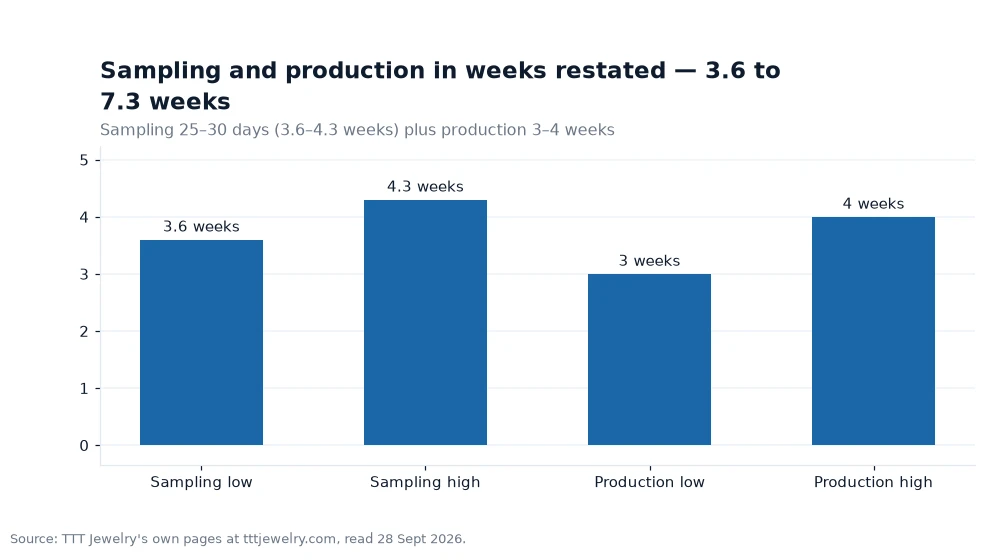
- Sampling at 25–30 days equals 3.6–4.3 weeks, and production at 21–28 days equals 3–4 weeks.
Where a wholesale buy actually starts
Wholesale pricing conversations usually begin with the unit rate and skip the structure underneath it. The structure is simpler: every design carries its own minimum, every metal carries its own minimum, and the calendar restarts for every new shape. A buyer who plans a 12-piece range in one metal is planning twelve separate commitments, not one order. That is the first arithmetic to run, before colour, before packaging, before freight.
The economics of a jewelry wholesale manufacturer China relationship start with those three figures because they set both the cash commitment and the exposure. A supplier that quotes one minimum for everything is either simplifying for the conversation or buying finished goods elsewhere. Neither is fatal, but both change how the reorder will behave.
There is also a model question underneath the minimum. An OEM/ODM jewelry manufacturer arrangement can mean the brand supplies a finished CAD file and the factory produces it, or the factory develops the concept and both sides co-create the collection. The second version usually consumes more of the consultation stage, because material and cost structure are settled as part of the design rather than handed over with it.
The minimum ladder by metal
The three published minimums are not arbitrary. Silver at 50 pieces per design is the lowest because the casting and finishing route suits short runs. Brass at 100 reflects a different tooling and plating rhythm. Stainless at 100+ is the volume line, where PVD plating and simpler assembly reward longer runs. Reading the ladder correctly tells a buyer which metal to use for which part of the range.
| Metal | MOQ per design | Plating route | Where it earns its place |
|---|---|---|---|
| 925 sterling silver | 50 pieces | Rhodium or gold over a protective coat | Higher retail price with a smaller stock position |
| Artisan eco-brass | 100 pieces | Multi-layer 14K, 18K or 24K gold with anti-tarnish e-coating | Broad trend ranges where shapes matter more than metal weight |
| 316L stainless steel | 100+ pieces | PVD vacuum plating | Shower-safe, swim-proof daily wear |
Two of those rows carry a hidden cost that rarely appears in a rate card. Brass needs the anti-tarnish coating because the substrate reacts with air and skin; skip it and the returns arrive in month three. Stainless needs the right grade, since 316L contains 2–3% molybdenum and is the version specified for water exposure, while 304 is a water-resistant daily-wear option for volume. The same PVD process on a lower grade gives a different product, even when the sample looks identical on day one.
Turning the lead time into a reorder point
A new design and a repeat order do not share a calendar. The 48–60 day figure covers CAD at 2 days, sampling at 25–30 days and production at 21–28 days. Once the mould exists and the sample is approved, the relevant window for a repeat is the 21–28 day production block, which is 3–4 weeks. That difference, roughly half the total cycle, is the whole reason a wholesale programme needs a reorder trigger rather than a launch date.
Put the trigger where the calendar can still respond. If production is 3–4 weeks and freight sits after it, an order placed when stock reaches a few weeks of cover will land after the shelf is empty. The practical rule is to count backwards from the sell-through date: freight, then production, then the approval window for any packaging or plating variation. New shapes need the full 48–60 days, so they belong in a separate planning lane from replenishment.
Sampling is 3.6–4.3 weeks on its own. That is long enough that a buyer should not approve a new design and a packaging change in the same week without checking which one is the critical path. The design waits for the mould; the packaging waits for artwork and print. They are different queues, and treating them as one is how a launch date gets missed by a fortnight.
Material is a claims decision
Every metal choice becomes a sentence on a product page. Sterling silver allows a 925 description and a rhodium finish. Eco-brass allows a gold-plated description with a coating caveat. 316L stainless allows a waterproof claim that survives a shower, because the molybdenum content resists the chlorides that attack lower grades. Choose the metal before writing the claim, not after.
Wholesale buyers also inherit the care instructions. A brass piece needs a dry cloth and a warning about perfume; a silver piece needs anti-tarnish storage; stainless needs almost nothing. Those instructions affect return rates more than the plating thickness conversation, because customers judge the product by what happens in week six, not by the sample they saw in the showroom.
Compliance sits alongside the claim. REACH restrictions on lead, cadmium and nickel apply to the material and the plating, and the published position is that plating is compliant with REACH and California Proposition 65. For a wholesale range sold into multiple markets, that sentence should be part of the product file rather than a line on the supplier's homepage.
Worked example
Plan a three-design range across all three metals. Silver: 3 × 50 = 150 units. Brass: 3 × 100 = 300. Stainless: 3 × 100 = 300. The buy is 750 pieces and nine base SKUs, and each metal adds its own plating approval. New shapes pass through two days of CAD, 25 to 30 days of sampling and 21 to 28 days of bulk. Adding the low ends gives 48 days, the high ends 60, a bracket of seven to nine weeks. A reorder skips the first two stages and runs 21–28 days, which is 44% of the 48-day cycle at the low end and 47% of the 60-day cycle at the high end. In weeks, sampling is 25/7 = 3.6 to 30/7 = 4.3, and production is 21/7 = 3 to 28/7 = 4, matching the chart below. The 750-unit buy therefore needs two calendars: one for the nine new SKUs and one for the replenishment that keeps them on the shelf.
Frequently asked questions
What is the MOQ for custom jewelry wholesale?
Minimums are per design: 50 pieces in 925 sterling silver, 100 in artisan eco-brass and 100+ in stainless steel. A range of several designs multiplies the figure, so the range plan should be set before the quote is requested.
How long does a wholesale order take from approval?
A new design runs 48–60 days: 2 days of CAD, 25–30 days of sampling and 21–28 days of production. A reorder against an approved mould runs the production block only, at 21–28 days.
Which metal should carry a daily-wear line?
316L stainless steel, because 2–3% molybdenum supports shower-safe and swim-proof wear and the surface takes PVD plating. Sterling silver and eco-brass suit edited ranges where the finish matters more than water exposure.
Building the buy around the calendar
Set the range, convert each design into a per-metal commitment, then place the new shapes and the replenishment on separate timelines. Keep the approved sample and its plating record with the reorder file, so a repeat does not reopen a settled question. Buyers who want the production model explained before the first purchase order can review factory direct manufacturing and compare it with the trading route, because the difference shows up in who owns the mould, the calendar and the reorder.
Source note: figures come from the manufacturer's own website (tttjewelry.com), read 28 Sept 2026.[1]