
The materials are rarely what damages an East Asian scent range at retail. The damage usually comes from decisions made around them: a story that promises more than the formula delivers, a natural material expected to behave like a synthetic, or a compliance question left until the artwork is at the printer. Every one of these mistakes is visible in advance and cheap to avoid, which is why they are worth listing plainly rather than discovering one launch at a time.
Key takeaways
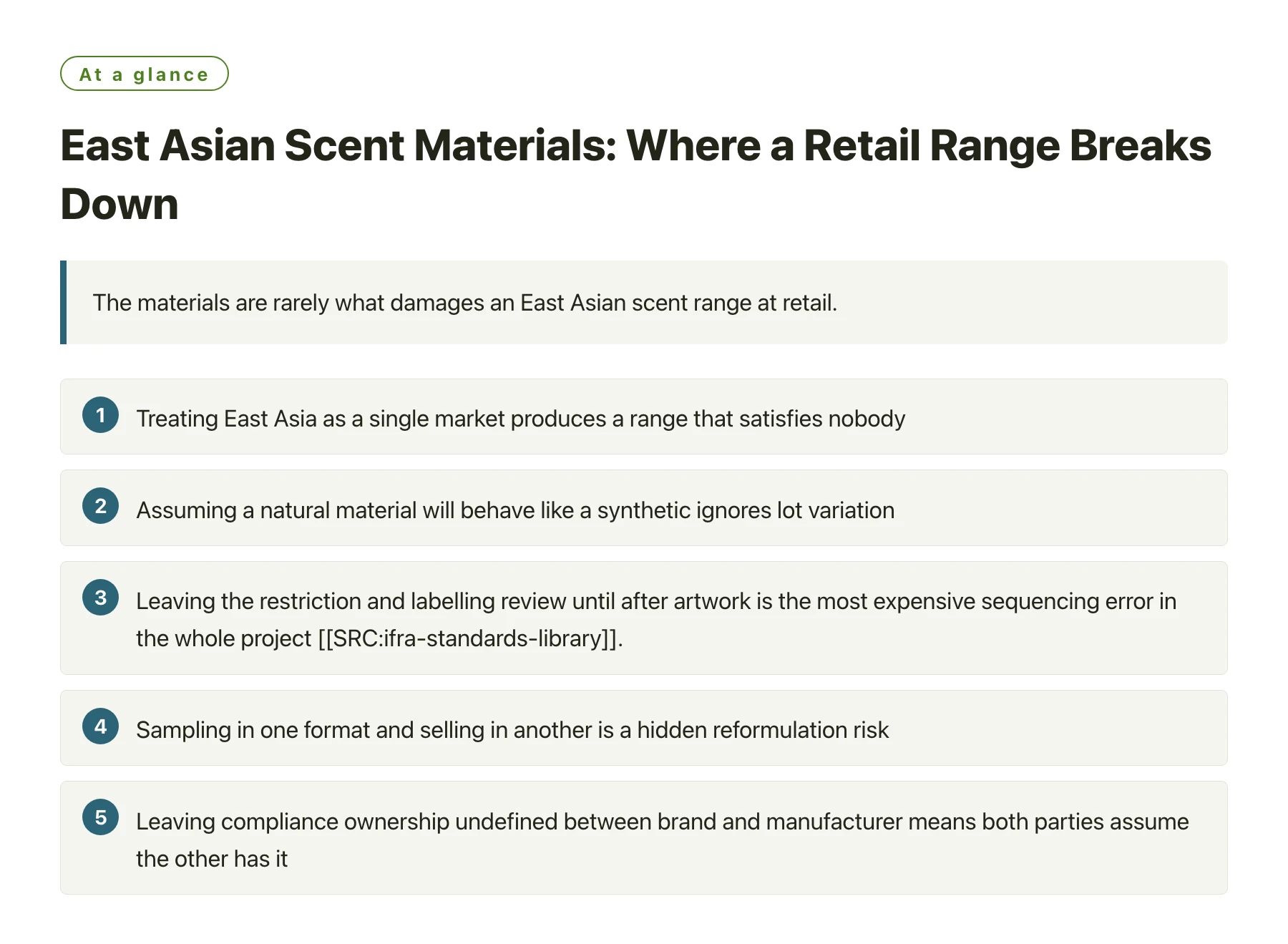
- Treating East Asia as a single market produces a range that satisfies nobody, because the reference points for a Guangzhou buyer and a Tokyo buyer are not the same.
- Assuming a natural material will behave like a synthetic ignores lot variation, colour drift and supply seasonality, all of which show up at retail volume rather than at sample scale.
- Leaving the restriction and labelling review until after artwork is the most expensive sequencing error in the whole project [1].
- Sampling in one format and selling in another is a hidden reformulation risk, because pack size and closure change how a formula ages.
- Leaving compliance ownership undefined between brand and manufacturer means both parties assume the other has it, and the gap appears at the border or at the store.
A department store launch has a way of exposing assumptions. Direct-to-consumer channels forgive a great deal, because the brand controls the messaging and can adjust quietly. A retail listing does not: the product sits under a fixed description, on a fixed shelf, with a compliance file that someone else has already reviewed.
What follows is a list of mistakes seen often enough to be predictable. None of them requires unusual knowledge to avoid; they require deciding early. The order runs roughly from strategy down to paperwork, which is also the order in which the costs accumulate.
If a range is already in development, read the list as an audit and check the two items that are hardest to reverse: the market definition and the compliance sequencing. Those two account for most of the expensive surprises.
Mistakes made before a single sample exists
The first group of errors is strategic, and it is the group that later decisions cannot repair. They usually appear as a brief that is either too broad to act on or too narrow to be interesting.
Treating East Asia as one market
East Asian scent references overlap without being identical. A tea-led construction that reads as refined in one market can read as dated in another, and the same is true of sweetness levels and of how much freshness a customer expects in a daily wear fragrance. Building one formula intended to travel across the region usually produces something that feels generic in all of them.
The practical alternative is to choose a lead market for the range and to treat other markets as adaptations rather than as the design target. That keeps the brief specific, and it makes the conversations with a manufacturer far easier, because a specific reference gives them something to work against. It is also the difference between a range that has a point of view and one that is merely described as Asian-inspired by what sets Chinese perfume brands apart.
Buying the material name instead of the effect
A brief that asks for osmanthus, tea and sandalwood is a shopping list, not a direction. Materials interact: a tea note can turn bitter over a heavy woody base, and a fruit-adjacent material such as osmanthus can read as syrupy if the top is not lifted. The mistake is ordering the list rather than describing the effect the customer should experience.
A better brief names the effect and treats the materials as candidates. That change alone shortens development, because the perfumer is free to reach the intended impression by a route that is more stable, more affordable, or both.
Mistakes made while the formula is being built
The second group shows up during development and testing. These errors are technical, but they are almost always caused by a commercial assumption that was never said out loud.
Expecting naturals to behave like synthetics
An extract is a mixture that moves with harvest, origin and processing. Two lots of the same material can differ in colour and in the balance of their facets, and the difference is large enough to be visible in a pale formula on a lit shelf. Expecting the same reproducibility a single-molecule material offers is the assumption that breaks.
The workable position is to decide, per material, how much variation is acceptable and how it will be managed: by holding a reference, by blending lots, or by anchoring the natural with a supporting material that keeps the profile steady. That decision belongs in development, not in a complaint six months later.
Skinny testing in the wrong pack
Compatibility and stability work is frequently run in a small development container and then assumed to hold for the retail pack. It often does not. A larger bottle with a different closure has different headspace and different light exposure, and the formula can age differently in ways a customer will notice before the brand does.
The fix is boring but effective: define the pack the store will sell before the final stability run, and test that configuration. If the pack is still undecided, test the two candidates rather than the development bottle.
Sequencing the restriction review last
Restricted materials are the most predictable source of late rework in fragrance development, and the reason is almost always sequence. The formula is finalised, the cost is agreed, the artwork is prepared, and only then does someone check whether a material is limited at the level used in that product category [1].
Moving the review earlier costs a conversation. Moving it later costs a reformulation, a new round of stability work and a new print run. The review should happen as soon as a candidate direction is selected, and the headroom for each restricted material should be recorded so a later cost reduction does not quietly consume it.
Mistakes made at the handover
The third group happens at the boundary between the brand and the manufacturer, where responsibility is easiest to assume and hardest to prove. Two of these mistakes cause more launch slippage than any technical problem.
Leaving compliance ownership undefined
In most markets the party placing the product on the market carries the obligations, and the factory supplies the inputs. When that split is left implicit, the brand assumes the manufacturer has produced the safety documentation and the manufacturer assumes the brand has a responsible person. The gap is discovered when the retailer asks for the file.
The subject matter is not exotic; cosmetic labelling, claims and product information obligations are documented publicly, and the categories that generate questions are well catalogued [2]. What matters is writing down, before production, who produces each document, who reviews it and who holds the master copy.
Letting the counter description drift from the formula
Retail copy is written by marketing, sometimes months after the formula was approved and revised. If the description claims a specific material that was later changed, or a natural origin that is actually a reconstruction, the discrepancy becomes a customer service problem and, occasionally, a legal one.
The cheap control is a single source of truth: one document listing the materials and their positions, kept current, that marketing copy is checked against before it is submitted. A manufacturer with a disciplined export process generally keeps this kind of record, and it is a reasonable thing to ask for from any a contract manufacturer for perfume brands before the range is committed.
Of the eight mistakes above, two are structural and cannot be fixed later: choosing one lead market, and completing the restriction review early. The rest are process errors that a written checklist removes. A useful test before committing a range is to read the material descriptions a manufacturer publishes about its own palette at https://www.xuelei.com and check whether your brief would produce the same level of specificity. If your brief is vaguer than a supplier's own material notes, the problem is upstream of the factory.
Sources
- IFRA Standards Library (International Fragrance Association) —— The IFRA Standards Library lists the restrictions the fragrance industry applies to individual fragrance ingredients, based on safety assessments; it is the reference point for compliant fragrance formulation.
- European Commission: Cosmetic Products — Specific Topics —— EU pages covering specific cosmetics topics such as product claims, nanomaterials and animal-testing rules.
Frequently asked questions
How many scent directions should a store range open with?
Enough to give the sales associate a clear recommendation path and few enough that each one is properly tested. Retail ranges often suffer from too many similar directions rather than too few, because the customer cannot tell them apart and the associate cannot explain the difference.
Are natural East Asian materials a problem for a retail listing?
They are not a problem in themselves, but they need a management plan. Lot variation, colour drift and seasonal supply all affect a retail range more than a direct-to-consumer one, so decide in advance which materials will be held to a reference and which will be stabilised with supporting ingredients.
What should be settled before the first sample round?
The lead market, the pack and pack size, the effect the scent should create, and the restriction position of any material likely to appear. Those four decisions determine whether the first round is a genuine selection or a rehearsal for the real one.
Who is responsible for cosmetic compliance when a factory manufactures the product?
Responsibility depends on the market, but the party placing the product on the market generally carries the obligation, while the manufacturer supplies formula and safety inputs. Because that split varies, the safest approach is to name the document owner for each item in writing rather than assuming the factory covers everything.
How can a brand avoid a late artwork change?
Complete the restriction, documentation and claim review before artwork is commissioned. If a material change is still possible, hold the artwork in a form that can be revised cheaply, and treat the final print approval as a milestone that only follows a signed-off technical file.
Ready to discuss your case?
Schedule a new-patient consultation with a dual-degree surgeon — typically within 4 days.