
Industrial Machinery & Manufacturing
What makes a heavy-duty horizontal machining center suitable for large-scale manufacturing?
A heavy-duty horizontal machining center processes massive castings with spindle torque often exceeding 500 Nm, which allows for aggressive material removal in large-scale production. Manufacturing facilities rely on automatic pallet changers to sustain spindle utilization rates consistently above 85%. With box-way construction providing superior vibration damping, these machines maintain positional accuracy within $\pm 5 \mu m$ throughout continuous operation. By gravity-assisted chip evacuation, tools operate at 30% higher speeds without degradation. In 2025, automotive plants adopted these configurations to reduce cycle times by 15%, ensuring structural integrity for engine blocks and transmission housings under sustained operational loads.
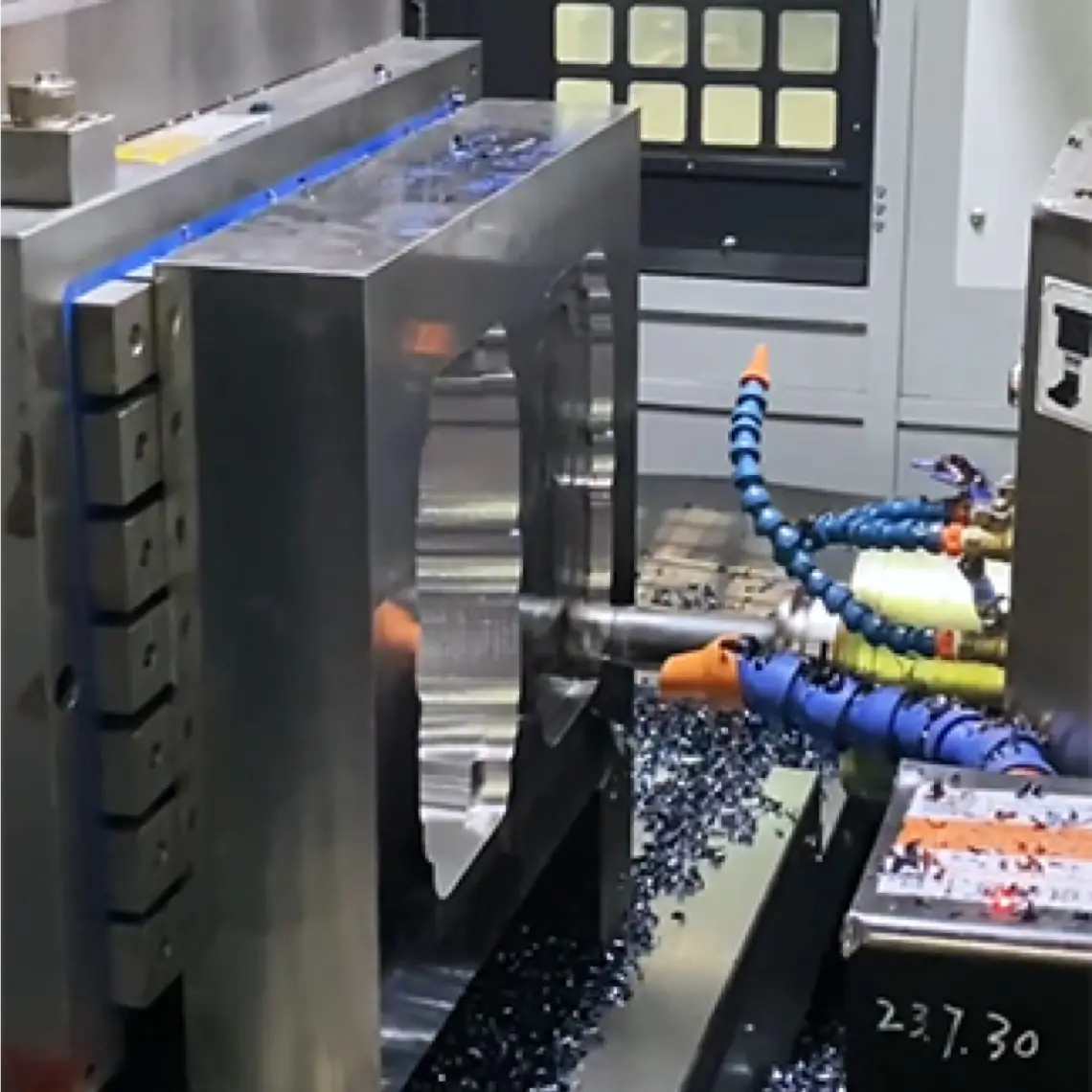
Heavy-duty production starts with machine bed mass exceeding 15,000 kg. This weight dampens the energy generated during aggressive roughing passes on large metal castings.
The inherent stability of a cast-iron foundation prevents structural deflection under heavy cutting loads. Vibration dampening is a natural result of this high static mass.
Machine mass functions as a passive dampener. Without sufficient weight, the energy from cutting forces creates chatter, which degrades the final surface finish of the machined part.
Because the structure stays steady, the cutting tools maintain consistent contact with the workpiece. This constant contact supports precise geometric output over long runs.
High-precision manufacturing requires maintaining tolerances within $\pm 0.005$ mm over thousands of distinct parts. A 2023 review of global automotive supply chains noted this consistency prevents assembly errors.
Consistent geometry depends on reliable spindle behavior during production cycles that last 24 hours. Thermal expansion can distort dimensions if not managed by active cooling loops.
Temperature sensors monitor the spindle head and machine column. When these components expand by even 0.01 mm, the controller adjusts the tool position to compensate for the drift.
Managing this heat necessitates advanced high-pressure coolant systems. These systems move heat away from the cutting zone at rates defined by fluid volume and pressure.
High-pressure through-spindle coolant delivers fluids at 70 bar directly to the tool tip. This flow flushes chips immediately from deep bores within the machine work zone.
Proper chip evacuation ensures that the tool never cuts the same metal twice. Data from 2024 shows this specific method extends carbide insert life by 25% compared to flood cooling.
Tool life improvement directly impacts consumable costs. By reducing the frequency of insert changes, operators spend more time monitoring quality and less time performing manual tool adjustments.
Longer insert life reduces the need for frequent manual tool changes. This reduction allows the machine to run for extended periods without operator intervention.
Automation bridges the gap between tool changes and active cutting time. Automatic pallet changers allow operators to load raw stock while the spindle works on a separate part.
In 2025, facilities using dual-pallet systems reported spindle utilization rates reaching 88%. This efficiency maximizes the total output of engine components per square meter of floor space.
Pallet loading happens externally. While the machine processes one tombstone fixture, the operator prepares the next, ensuring the spindle starts the next cycle the moment the previous one finishes.
Maximizing space leads to higher throughput for automotive plants. Increased throughput requires the ability to switch between different part geometries with minimal downtime.
Processing tough alloys like steel or ductile iron requires high torque output. Spindle motors often generate torque exceeding 500 Nm at low RPM.
High torque prevents spindle stalls during heavy-duty face milling. This power capability allows for faster metal removal rates, often increasing volume by 20%.
Torque curves remain flat across the lower speed range. This ensures that the machine provides full cutting power even when using large-diameter drills or facing heads on engine blocks.
Faster metal removal requires rigid rotary indexing for multi-face processing. Rotary B-axis tables allow access to multiple part faces in a single setup.
A single fixture setup reduces positional errors by 40% compared to moving parts between separate machines. The machine locks the table to provide a stable platform for heavy milling.
Indexing precision is measured in arc-seconds. Standard tables provide repeatability within 2 arc-seconds, which ensures that bore patterns align perfectly across the entire part.
Precision in indexing ensures that bore alignments remain true across thousands of units. Reliability becomes predictable when the machine manages the part rotation without manual input.
Predictable rotation cycles rely on intelligent control units to manage motion. Modern controllers process over 1,000 blocks of NC code per second for smooth interpolation.
This processing speed allows for smooth interpolation of complex contours. Software compensation adjusts for thermal shifts in real-time, maintaining dimensional stability.
Look-ahead buffers in the CNC control allow for high-speed calculation. The machine anticipates changes in direction to keep feed rates constant, preventing surface dwell marks.
Maintenance teams observed that 95% of dimensional variance stems from temperature changes. Correcting for these temperature changes secures long-term repeatability for high-volume orders.
Repeatability stands as the hallmark of large-scale, automated production lines. Machines calibrated to factory specifications maintain 99.9% dimensional reliability.
This standard applies to aerospace structural parts produced in 2026. Consistent results reduce the need for secondary inspection stations downstream from the machining center.
Inspection requires coordinate measuring machines. When the production process maintains 99.9% reliability, inspection frequency shifts from every part to sampling intervals, saving time.
Eliminating inspection stations streamlines the production flow. Efficient production balances power draw with high metal removal rates.
Regenerative drives recover energy during axis deceleration in 2025 models. Reducing power usage lowers the operational cost per part manufactured.
Sustainability targets encourage facilities to track electricity consumption per cycle. Tracking this consumption leads to optimized production schedules that avoid peak energy pricing.
Energy monitoring software tracks every kilowatt used during the cycle. By analyzing this data, managers schedule the most energy-intensive operations during off-peak grid demand periods.
Predictive maintenance uses vibration sensors to monitor bearing health. These sensors identify wear patterns long before mechanical failure stops the line.
Data from a sample of 100 machines showed a 40% reduction in unscheduled downtime. Reliable machines operate continuously to meet high-volume production schedules.
Ready to discuss your case?
Schedule a new-patient consultation with a dual-degree surgeon — typically within 4 days.